透過資料二極體傳送日誌、警示與遙測資料

Find Out How
我們利用人工智慧進行網站翻譯,雖然我們力求準確性,但它們可能並不總是 100% 精確。感謝您的理解。

Securing Hospital Data Flows with Hardware-Enforced Protection

作者: OPSWAT 發布
分享此文章

Healthcare organizations face a difficult reality. Cyber criminals actively target hospitals, clinics, and medical research centers. In 2024 alone, healthcare-related cyber incidents affected 259 million Americans, and the average cost of a breach in early 2025 reached 7.42 million dollars.

Attackers know that when systems go down, patient care suffers. That pressure increases the likelihood of ransomware payment. Hospitals also manage high-value patient data and often rely on systems that run around the clock. Many of these systems are older and difficult to patch without disrupting clinical operations.

Before we look at how to reduce risk, it helps to understand how hospital data actually moves.

How Hospital Systems Exchange Data

Hospital systems exchange data via two primary communication standards: HL7 (Health Level Seven) and DICOM (Digital Imaging and Communications in Medicine).

When a physician orders an MRI, the Electronic Health Record system captures the patient’s identifying information, clinical notes, and the requested procedure. That information must move from the EHR (Electronic Health Record system) to the imaging department quickly and accurately.

HL7: The Language of Hospital Systems

HL7 is the standard hospitals use to exchange patient data, lab results, orders, and billing information.

Think of HL7 as a common language. It allows systems such as EPIC, Cerner, and other health management platforms to understand each other. When the physician places the imaging order, the EHR sends patient demographics and diagnostic codes to the imaging center using HL7.

Without HL7, each system would speak its own dialect. With it, the hospital operates as a coordinated network.

DICOM: Moving the Images

Once the scan is complete, the imaging modality, such as an MRI, CT, or X-ray machine, generates high-resolution diagnostic images. These images move to the central PACS (Picture Archiving and Communication System) using DICOM.

DICOM handles the transfer of imaging data, while HL7 continues to manage patient and order information. The imaging system receives patient details over HL7 and sends the resulting images over DICOM.

Both protocols operate over TCP/IP, which ensures reliable delivery of data to the intended endpoint.

Putting It All Together

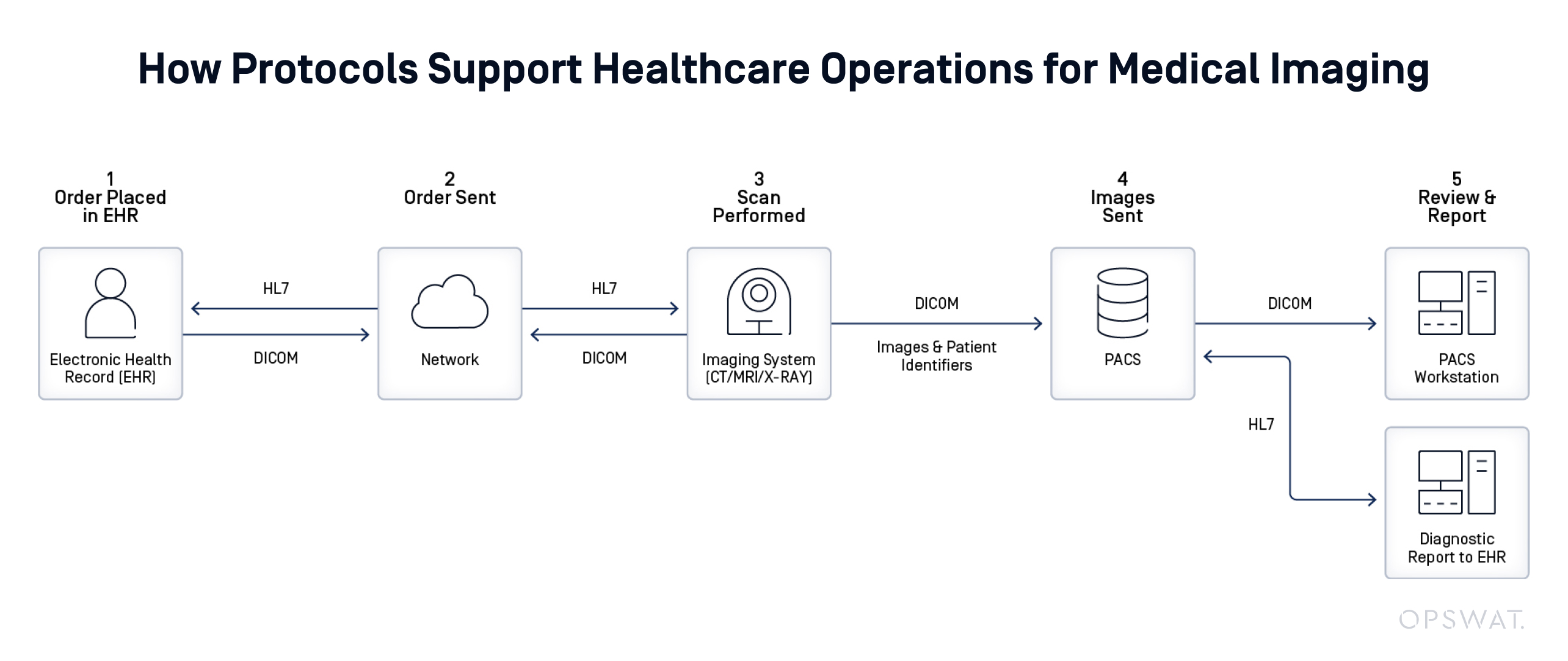
Here is how the full process works in practice:

  1. The physician places an imaging order in the EHR
  2. The EHR sends patient information to the imaging center using HL7
  3. The imaging system performs the scan
  4. The completed images, along with patient identifiers, transfer to the PACS system using DICOM
  5. The physician reviews the images and adds a diagnostic interpretation to the patient’s electronic record

This architecture supports efficient and coordinated care. At the same time, it introduces multiple potential vulnerability points across the workflow, from order transmission to image storage and diagnostic review.

How Can Data Diodes Secure Hospital Network Infrastructure?

The same connections that allow hospital systems to work together can also introduce risk. Imaging machines, PACS archives, EHR platforms, and remote diagnostic centers must exchange data constantly. If an attacker finds a way into one part of the network, that connection can become a pathway deeper into clinical systems.

This is where a data diode changes the equation.

What a Data Diode Does

A data diode is a network security device that enforces strictly one-way data flow. Data can move in a single direction across a hardware-enforced boundary, but it cannot travel back.

Unlike software-based firewalls, which rely on rules that can be modified or misconfigured, a data diode creates a physical barrier. Often implemented over fiber optics, it makes it technically impossible for traffic to return to the protected network.

In a hospital setting, this means you can allow critical clinical data to move where it needs to go while preventing threats from coming back into sensitive systems.

How Data Diodes Secure Remote Imaging Centers

Remote imaging centers must exchange DICOM images and HL7 patient data with central hospital systems, creating bidirectional data requirements across distributed locations. Without strict network segmentation, these connections can expose high-value PACS and clinical systems to compromise.

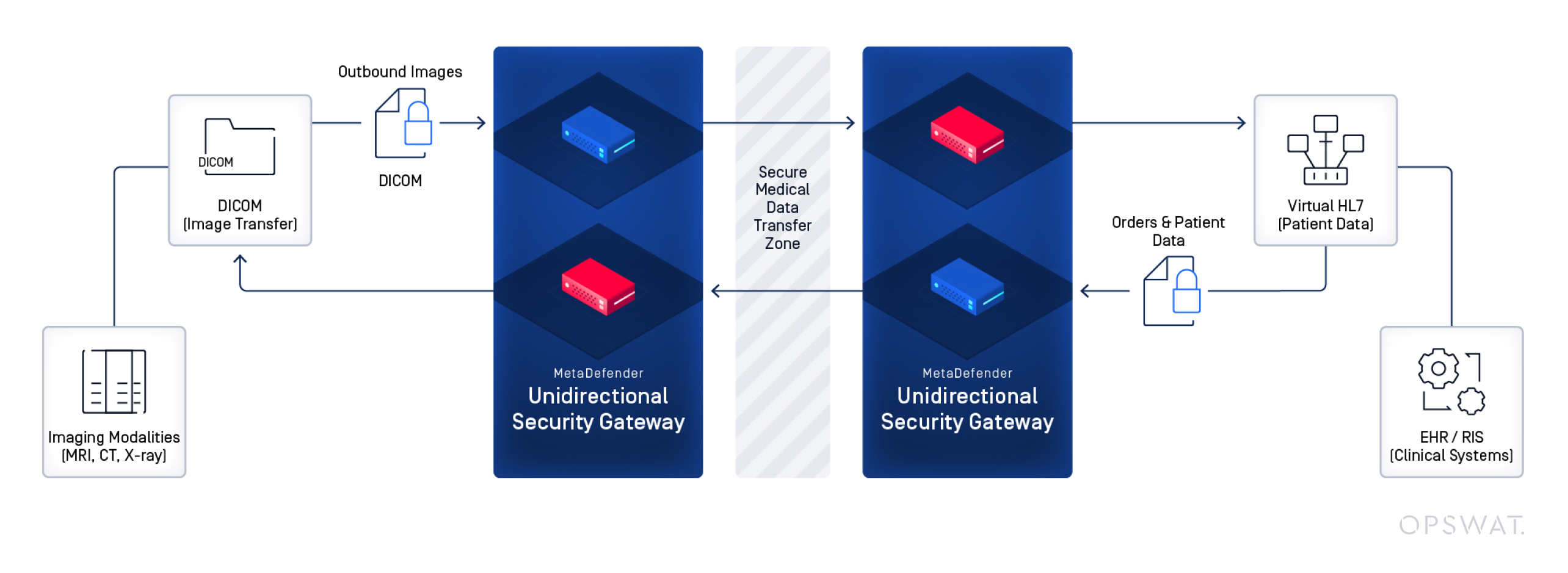
Consider a hospital with multiple remote imaging centers. These centers need to send high-definition DICOM images to a central PACS archive for storage and review. At the same time, they must receive HL7-based patient and order information from the main hospital system.

By deploying dedicated unidirectional gateways between the remote center and the core hospital network, you control each direction of data flow. One unidirectional path can move DICOM images securely toward the central PACS. A separate unidirectional path can deliver HL7 patient and order information to the imaging center. Each link enforces a single direction, eliminating the possibility of return traffic into protected systems.

The architecture supports clinical operations while preventing external threats from reaching high-value systems. The unidirectional gateway ensures that even if a remote location is compromised, attackers cannot use that connection to breach the central archive.

You can also use a unidirectional gateway in the other direction when you need to share studies for remote reading. For example, the hospital can send DICOM images from the central PACS to a remote analysis environment, so specialists can review them, without creating a path back into the PACS archive.

Protecting Medical and Operational Systems

Hospitals rely on specialized equipment that often runs on legacy platforms and cannot be frequently updated.

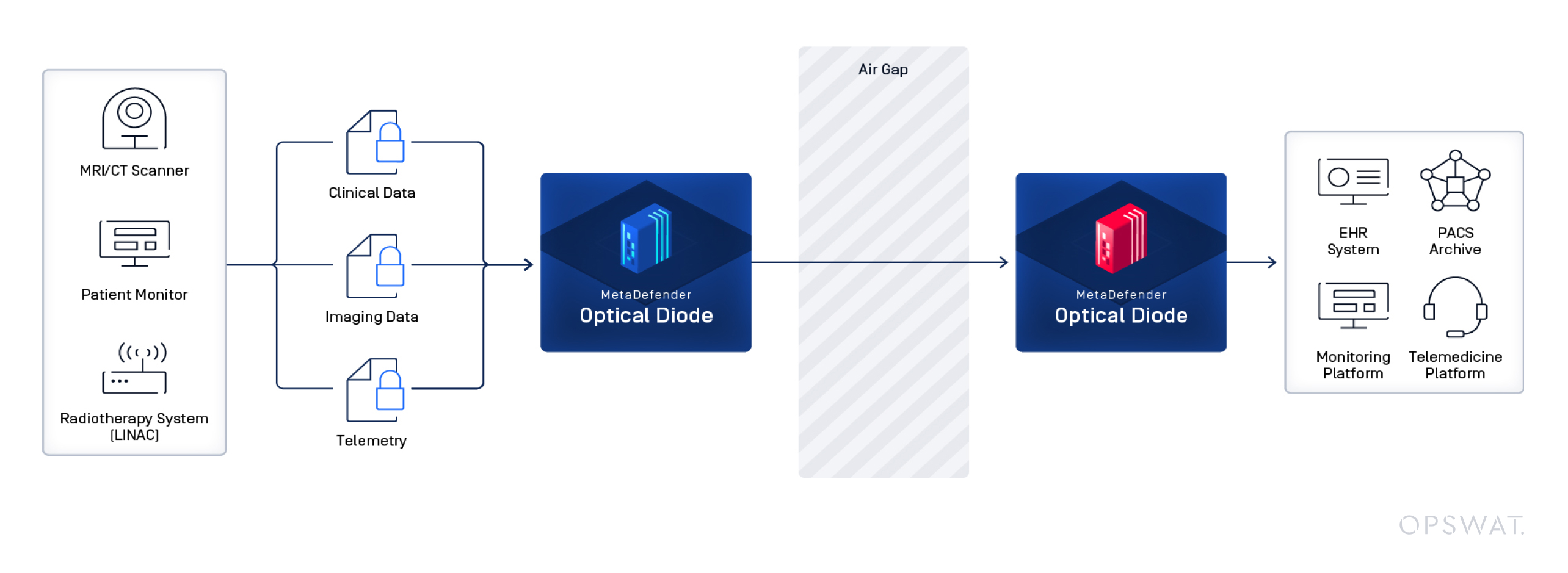
Data diodes help isolate operational technology networks, such as MRI machines, bedside monitors, and other clinical devices, from the broader IT environment. You can stream data out for analysis, monitoring, or storage without exposing these devices to internet-borne threats such as ransomware.

Radiology oncology systems face similar risks. These systems represent significant capital investments and play a direct role in patient treatment. A compromise could lead to financial loss and safety concerns. Unidirectional protection limits that exposure.

Extending Protection Across the Healthcare Ecosystem

Data diodes also support:

  • Telemedicine and remote monitoring, by allowing data from home health devices or video streams to enter the healthcare network without creating a return path for attackers.
  • Pharmaceutical research and manufacturing environments, by exporting production or clinical trial data for analysis while preventing remote tampering with manufacturing systems.
  • Large data repositories such as Electronic Health Records and payer databases, by controlling how data enters and exits critical systems.
  • Research workflows, when paired with data loss prevention tools to replicate clinical data while redacting patient identifiers for trials and studies.
  • Regulatory compliance efforts, by providing hardware-enforced separation that demonstrates data integrity and privacy in line with FDA, HHS, and HIPAA requirements.

In each case, you allow necessary data movement while reducing the risk that a single compromised system can affect the entire healthcare environment.

Introducing MetaDefender Optical Diode™ for Healthcare Environments

Hospitals need more than network rules. They need assurance that critical systems remain isolated, even as data moves between departments, campuses, and remote facilities. MetaDefender Optical Diode provides that assurance through hardware-enforced unidirectional security.

The optical diode component physically allows light to transmit in only one direction across a fiber link, preventing any return traffic into protected networks. A unidirectional security gateway architecture then enables controlled data transfer across this one-way boundary.

Hardware-Enforced One-Way Transfer

MetaDefender Optical Diode physically enforces one-way data flow between networks. It allows hospitals to move HL7 messages, DICOM images, and other clinical data across defined boundaries without creating a bidirectional connection.

This approach protects high-value systems such as PACS archives, radiology platforms, oncology systems, and EHR repositories. Even if a lower-trust or remote network is compromised, attackers cannot use that connection to move back into protected environments.

Designed for Secure Data Transfer Workflows

Healthcare data flows are not limited to simple file transfers. Hospitals must handle:

  • High-resolution medical images
  • Patient records and diagnostic codes
  • System and software updates
  • Operational data from medical and monitoring devices

MetaDefender Optical Diode enforces hardware-based unidirectional transfer as part of a broader cross-domain security architecture. Organizations can layer advanced inspection, content validation, and policy controls alongside the diode, ensuring that data moving between networks meets security and compliance requirements before and after crossing the boundary.

Enabling Protection Without Disrupting Care

Clinical operations cannot pause for security maintenance. Imaging systems run continuously. PACS environments store years of diagnostic history. EHR platforms support real-time care decisions.

MetaDefender Optical Diode allows hospitals to strengthen network segmentation without interrupting these workflows. You maintain the efficiency of HL7 and DICOM-driven processes while adding a layer of physical security that cannot be bypassed through software manipulation.

This balance between operational continuity and high-assurance protection is critical in environments where downtime affects patient care.

Securing Clinical Workflows for Modern Healthcare

Healthcare organizations remain a primary target for cyberthreats. Hospitals depend on constant data exchange between EHR systems, imaging devices, PACS archives, and remote facilities. Each connection supports patient care, but each also introduces risk.

Hardware-enforced unidirectional security changes that risk profile. By allowing data to move in only one direction across critical boundaries, hospitals can protect life-critical systems, reduce ransomware exposure, and strengthen compliance with regulatory requirements.

To learn how MetaDefender Optical Diode can be deployed within your hospital or healthcare network, contact an OPSWAT expert to discuss your specific data transfer architecture and security objectives.

常見問題

1. How does a data diode protect hospital networks?

A data diode enforces hardware-based, one-way data transfer between networks. It physically prevents return traffic into protected environments such as PACS, EHR systems, and imaging platforms. This eliminates lateral movement pathways that ransomware and network-based attacks rely on.

2. How can hospitals transfer data if the connection is one-way?

Hospitals deploy dedicated unidirectional paths for each required direction of transfer. One path can move DICOM images to a central PACS, while a separate path delivers HL7 patient data to remote imaging centers. Each path is independently enforced in hardware.

3. What hospital systems benefit most from unidirectional security?

High-value systems such as Picture Archiving and Communication Systems (PACS), Electronic Health Records (EHR), radiology platforms, and oncology systems benefit most. These systems store sensitive patient data and support life-critical workflows that must remain continuously available.

4. How does unidirectional security support HIPAA compliance?

Hardware-enforced separation helps protect electronic protected health information (ePHI) by preventing unauthorized return traffic into regulated systems. This strengthens safeguards aligned with HIPAA security requirements and reduces breach exposure.

5. What makes MetaDefender Optical Diode suitable for healthcare environments?

MetaDefender Optical Diode enforces physically unidirectional network transfer while supporting hospital data workflows such as HL7 and DICOM movement. It enables secure segmentation without disrupting clinical operations, helping healthcare organizations reduce ransomware risk and protect critical systems.

隨時瞭解OPSWAT 的最新資訊!

立即註冊,即可收到公司的最新消息、 故事、活動資訊等。