When Internal Threat Activity Stays Hidden
The organization’s core challenge was limited visibility inside the network. While its existing security tools helped defend the perimeter, they provided limited insight into internal communications across operational technology, enterprise systems, and grid-related environments. That left the SOC with three operational gaps that increased risk and slowed response.
1. East-west traffic across OT and IT was difficult to monitor
Control systems, industrial devices, and monitoring platforms generate constant internal communications, much of which appears routine. In this environment, traditional monitoring tools lacked the visibility needed to distinguish legitimate operational traffic from suspicious internal movement. As a result, the SOC had limited ability to observe lateral activity within OT segments or across the boundary between operational and enterprise networks.
2. The SOC depended on delayed indicators to identify threats
Without continuous network-level visibility, analysts often had to rely on endpoint alerts or abnormal system behavior to detect suspicious activity. These signals typically appeared later in the attack lifecycle, after an attacker had already established a foothold and begun moving across internal systems. That reduced the team’s ability to detect threats early and act before risk expanded.
3. Investigations started with fragmented context
Because internal threat activity was not clearly visible at the network layer, the SOC had to reconstruct incidents from partial evidence across multiple tools. This slowed root cause analysis and made it harder to understand the scope of a potential incident quickly. In a critical infrastructure environment, that lack of context increased operational pressure and reduced confidence in early response decisions.
What the Organization Needed to Close the Gap
The organization needed more than additional monitoring. It needed a detection capability purpose-built for complex, mixed OT and IT environments where threat activity is designed to blend in.
Continuous, internal network visibility
The core requirement was the ability to observe east-west traffic across OT environments, control networks, and enterprise systems simultaneously within a single platform, including visibility into encrypted traffic analytics without decryption.
Behavioral detection capable of identifying subtle anomalies
Signature-based tools had already proven insufficient. The organization required analytics that could continuously analyze network behavior across mixed OT and IT environments and flag deviations indicative of lateral movement and command-and-control activity, even when that activity mimicked legitimate operational traffic.
A network detection capability that identified threats earlier in the attack lifecycle
The SOC needed to move away from depending on delayed endpoint alerts. That required a solution capable of analyzing internal traffic patterns and surfacing abnormal network behavior before it reached the point of observable system impact.
Network Intelligence Replaced Uncertainty with Visibility
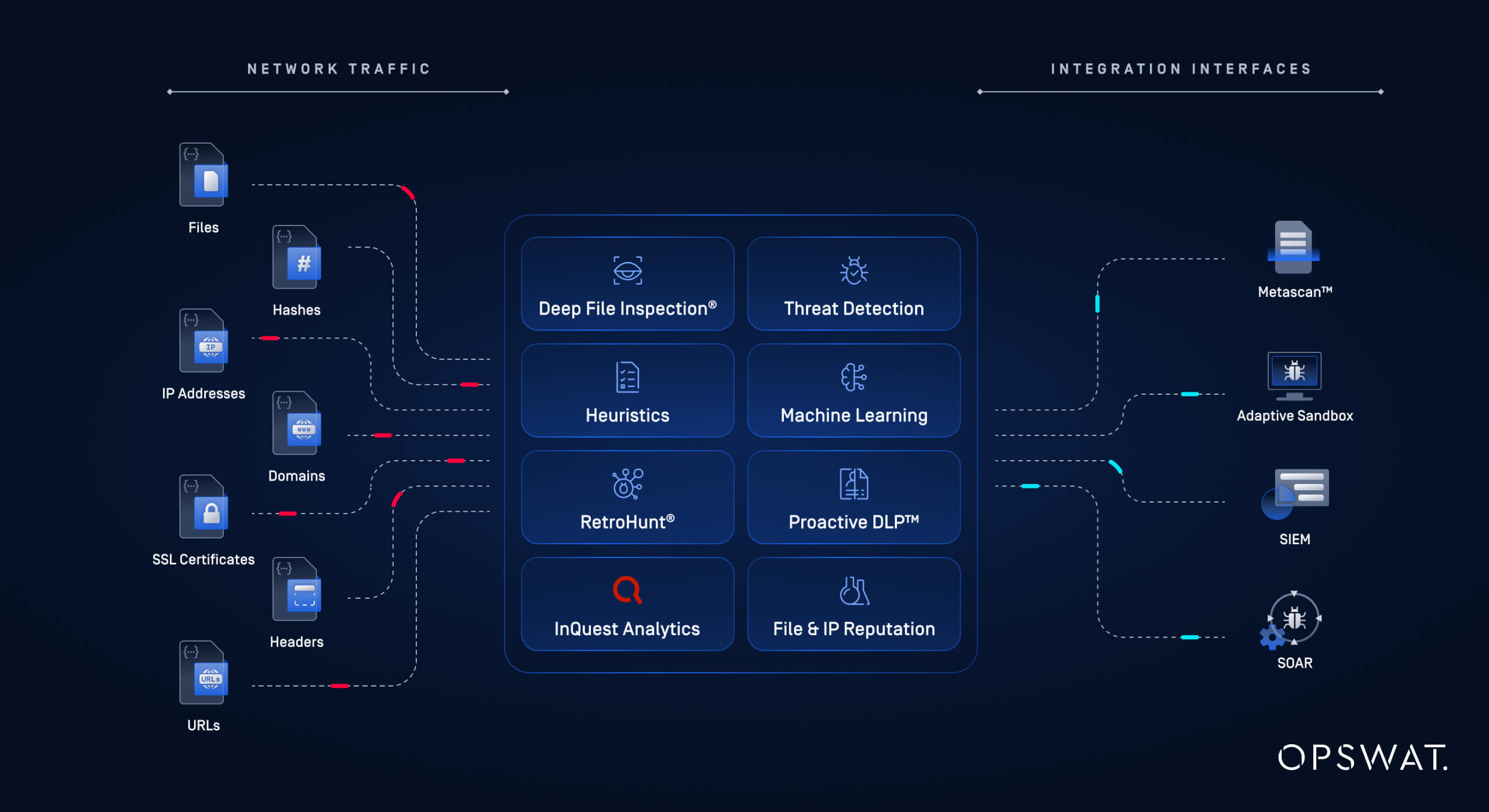
The organization needed a purpose-built network detection capability to eliminate the visibility gaps that traditional tools could not address. SOC deployed MetaDefender NDR to have a unified, near-real-time view of internal communications.
The deployment placed sensors at major network aggregation points across OT infrastructure, control networks, and enterprise segments. For the first time, analysts could observe communications between control systems, substations, and enterprise platforms in a unified view. Internal network activity that had previously been invisible was now part of the detection picture.
The platform went to work across three fronts simultaneously:
- Behavioral analytics combined with integrated threat intelligence and AI-driven anomaly detection ran continuously against live network telemetry, identifying patterns associated with lateral movement, beaconing, and command-and-control communications
- Alerts were enriched with contextual intelligence through MetaDefender InSights, enabling faster triage without manual cross-referencing across tools
- Network-level findings fed directly into existing SOC workflows, replacing fragmented alert correlation across multiple systems with a unified investigation view
The operational shift was immediate. MetaDefender NDR provided detailed network telemetry and contextual intelligence that allowed analysts to begin investigations with a more complete network-level view of attacker activity rather than a fragmented set of endpoint alerts. Unified threat intelligence and AI-driven investigation workflows meant the scope of a potential incident could be determined faster and with greater confidence.

The SOC Gained the Visibility Needed to Act Earlier
MetaDefender NDR delivered clear improvement across visibility, detection, and investigation workflows. Threats that had previously gone undetected were now visible earlier in the attack lifecycle. Analysts could detect threats earlier, investigate faster, and respond with greater confidence.
Network visibility: OT segments, control networks, and enterprise systems were observable simultaneously for the first time. Attacker activity that would previously have gone undetected could now be identified as it occurred.
Threat detection: Behavioral analytics and AI-driven anomaly detection identified suspicious traffic patterns before they reached the endpoint layer. Lateral movement and command-and-control communications were flagged based on behavioral deviation, not only known signatures.
Investigation timelines: SOC analysts no longer needed to reconstruct incident scope from fragmented endpoint alerts. Network-level telemetry provided a complete view of attacker activity, enabling faster root cause analysis and more confident containment decisions.
Infrastructure protection: With visibility into communications across operational networks, the SOC could identify threats targeting control systems and respond before those threats could reach grid management platforms or disrupt power operations.
Outcomes Delivered by MetaDefender NDR Across Key Areas
| Area of Impact | 結果 |
|---|---|
| Network visibility | Unified view across OT, control networks, and enterprise systems |
| Threat detection speed | Earlier identification of lateral movement and suspicious traffic |
| Investigation efficiency | Faster root cause analysis with complete network-level context |
| Infrastructure protection | Improved protection of grid operations and control systems |
| Incident response | Better-coordinated response across energy sector security teams |
| Compliance readiness | Continuous monitoring aligned with critical infrastructure security standards |
A Stronger Cyber Defense Posture for Critical Infrastructure
Defending energy and utility infrastructure environments requires more than perimeter protection or endpoint security. By deploying continuous network monitoring across OT and enterprise environments, the organization's SOC gained the intelligence needed to detect attacker activity earlier, investigate incidents faster, and respond before threats could disrupt energy services or critical infrastructure systems.
The result is a security operation that no longer depends on delayed indicators to detect internal threats. Network intelligence is now a core capability, and the SOC is positioned to defend the infrastructure it protects with significantly greater confidence.
Protect your energy infrastructure with advanced network visibility and behavioral threat detection. Find out what MetaDefender NDR can do for your SOC.