您絕對不能錯過的更新:Office 2016 與 Office 2019 支援終止

立即閱讀
我們利用人工智慧進行網站翻譯,雖然我們力求準確性,但它們可能並不總是 100% 精確。感謝您的理解。

The Axios npm Attack: How a Trusted Package Became a Malware Delivery System

By OPSWAT
分享此文章

Npm package hijacking is a software supply chain attack that turns trust in a package into the attack path. Attackers do not need to modify repository code if they can control the account that publishes the package.

That is what makes trusted npm packages such a powerful attack surface. When a maintainer account is compromised, every project that installs the affected package can be exposed through a routine dependency update. The March 2026 Axios incident showed how one compromised npm account could put more than 100 million weekly downloads at risk without changing axios source code in any visible way.

Understanding how npm package hijacking works helps security teams build controls that address the real attack path rather than only the source files most teams review.

What Happened in the Axios npm Attack

The Axios npm attack was a maintainer account takeover that turned a trusted package into a malware delivery mechanism. The attacker compromised the primary axios maintainer’s npm account, changed the registered email to an attacker-controlled address, and locked the legitimate maintainer out.

The operation was staged and deliberate. A decoy package was published about 18 hours before the payload was activated, creating publishing history without immediate suspicion. Then, within roughly 39 minutes, the attacker pushed two malicious versions: axios 1.14.1 for the modern release branch and axios 0.30.4 for the legacy branch.

Both release lines were targeted at the same time to maximize exposure. That choice increased the likelihood that both current and legacy environments would pull a poisoned package through standard update behavior.

How a Single Line in package.json Became the Attack Vector

A single dependency change in package.json can become the entire attack path in an npm supply chain attack. In the Axios incident, no axios source files needed to be changed because the malicious behavior was introduced through a new dependency. 

That dependency executed through an npm postinstall hook. As soon as a developer workstation, CI/CD pipeline, or build system ran npm install, the malicious package could contact an attacker-controlled server, retrieve an operating system-specific payload, and begin execution. 

The payloads were prepared for macOS, Windows, and Linux. The attack was cross-platform by design. After running, the dropper removed traces of itself and replaced the real package.json with a falsified version, making later forensic review much harder. 

Why Traditional Code Review Did Not Catch the Axios Attack

Traditional code review is built to inspect source code changes inside a repository, but this attack path did not live in axios source code. The Axios attack did not rely on visible repository changes because the malicious logic lived in a separate dependency rather than in axios source code. 

That difference matters. A reviewer looking at the package update would see little more than a new dependency line in package.json. The actual malicious behavior appeared only when the dependency was resolved and installed. 

This is why trusted package attacks are difficult to catch with diff-based review alone. The attack path sits outside the source files most teams inspect, even though the package still appears legitimate enough to pass through routine development workflows. 

Why the Blast Radius Is Everything the Package Touches

The blast radius of a compromised npm package is not the package itself. The blast radius is everything the package touches. 

For most organizations, that includes CI/CD pipelines with elevated permissions, developer endpoints with SSH keys and cloud tokens, build servers with write access to artifact repositories, and deployment tooling connected to production systems. A malicious package does not need to remain inside the dependency tree to cause damage. It only needs one trusted execution point. 

That is why the Axios incident matters beyond JavaScript package management. A postinstall-based compromise can turn a normal install event into credential theft, lateral movement, or downstream infrastructure access. 

Structural Weaknesses the Axios Attack Exposed

The Axios incident exposed structural weaknesses that are common across modern software development environments. These are not rare edge cases. They are normal assumptions in many organizations. 

Trust in Package Maintainer Identities

npm package trust is often anchored to the maintainer account that publishes the package. If that account is stolen or phished, the attacker inherits the same publishing authority as the legitimate maintainer.

Floating Dependency Versions

Floating or loosely pinned version ranges increase exposure to malicious releases. A newly published compromised version can enter an environment automatically without a deliberate approval step.

Unmonitored postinstall Scripts

npm postinstall scripts can execute arbitrary code with the permissions of the installation process. Many organizations do not inspect or restrict lifecycle scripts before they run.

CI/CD Pipelines with Limited Runtime Visibility

CI/CD pipelines frequently hold broad access to internal systems, build infrastructure, and cloud environments. Those pipelines are often trusted by default and are rarely monitored for malicious package behavior at install time.

Developer Endpoints Outside Full Security Coverage

Developer machines store high-value assets, including SSH keys, cloud credentials, and enterprise tokens. Developer endpoints are also common execution targets because they may have less visibility and fewer runtime controls than production systems.

Credential Stores Without Fast Rotation Triggers

A software supply chain attack often becomes a credential exposure event. Many teams still do not have reliable workflows that identify potentially exposed secrets and rotate them immediately.

What Security Controls Would Have Changed the Outcome

Three categories of security control would have materially reduced the impact of the Axios attack. Each control addresses a different point in the attack chain: package execution, credential exposure, and dependency visibility.

1. Package-Level Malware Scanning Before Installation

Package-level malware scanning helps stop malicious dependencies before they execute. That matters in npm attacks because postinstall hooks run during installation, which leaves little time for manual review once the package is pulled.

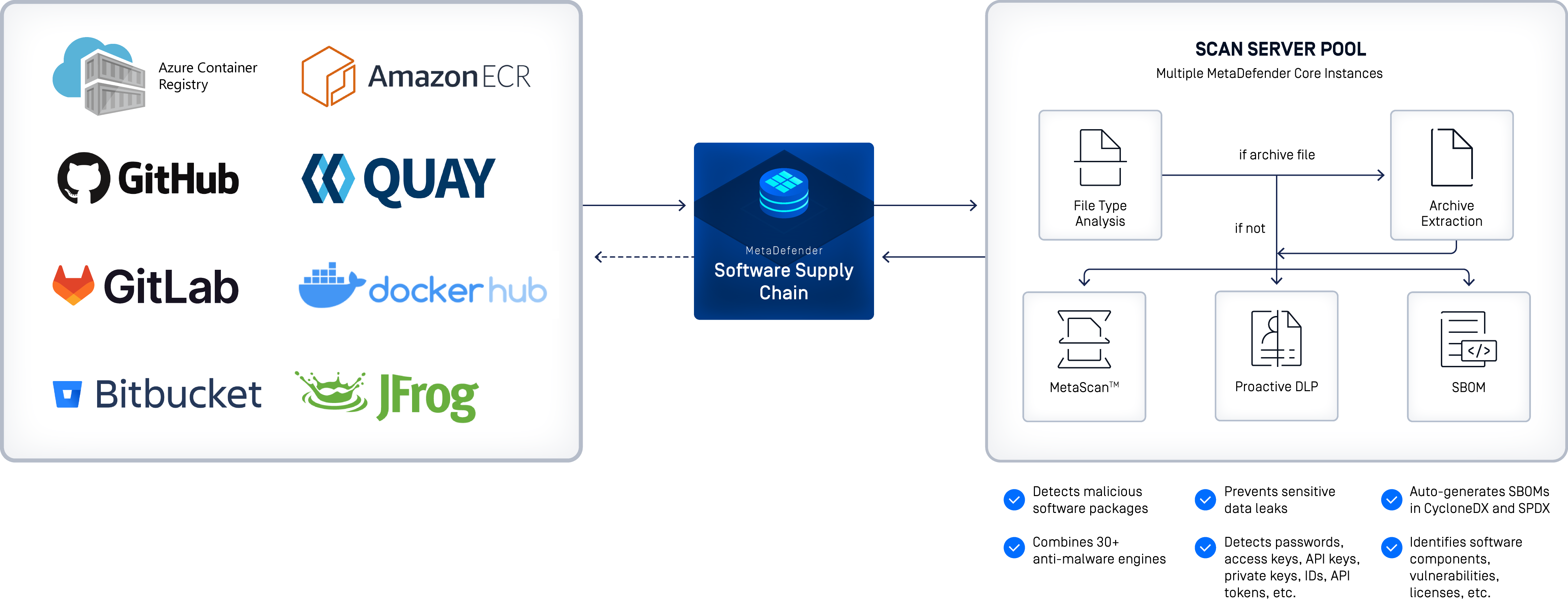
Scanning packages, dependencies, and lifecycle scripts before installation can identify known malware, suspicious behaviors, vulnerabilities, and hardcoded secrets before the package reaches a developer endpoint or CI/CD environment.

MetaDefender Software Supply Chain is OPSWAT’s software supply chain security solution for validating software components, vendors, and build pipelines. It uses multi-engine threat detection, including Metascan multiscanning across 30+ antivirus engines, to inspect packages for malware, vulnerabilities, and hardcoded secrets before they enter the development lifecycle.

2. Proactive Secrets Management with Rotation Triggers

Proactive secrets management reduces the value of a successful compromise. When a suspicious package is identified, teams need a response path that treats local credentials, SSH keys, tokens, and pipeline secrets as potentially exposed and rotates them quickly.

Hardcoded secret detection supports the same goal. A malicious package can steal secrets from memory or disk, but exposed secrets already present in code or dependencies add another preventable layer of risk.

3. Supply Chain Visibility and Dependency Monitoring

Supply chain visibility helps teams detect unexpected package changes before those changes become downstream incidents. Security teams need to know which packages are installed, which versions are pinned, which new dependencies have appeared, and where those components are running.

Without dependency visibility and monitoring, the first sign of compromise may be credential abuse or infrastructure misuse after the original install event is long gone.

Learn More About Software Supply Chain Security

Software supply chain security depends on inspecting packages before execution, monitoring new dependencies, and reducing the credential exposure that follows a package compromise.

Watch the on-demand webinar: Software Supply Chain Secrets — The Weak Links Attackers Exploit

常見問題

What is an npm supply chain attack?

An npm supply chain attack is the delivery of malicious code through the npm ecosystem during normal software development activity. Attackers usually achieve this by compromising a maintainer account, publishing a deceptive package, or inserting malicious behavior into dependencies that developers and CI/CD systems install automatically.

How did attackers compromise the Axios npm package?

Attackers compromised the primary axios maintainer’s npm account and used that publishing access to release malicious versions across both the 1.x and 0.x release branches. The attackers also changed the account email to an attacker-controlled address, which helped them maintain control of the package.

What did the malware in the Axios attack do?

The malware in the Axios attack used a postinstall hook to execute during npm install. The hook contacted an attacker-controlled server, downloaded a remote access trojan for macOS, Windows, or Linux, launched it, and then attempted to erase traces by replacing package metadata with falsified content.

Why did code review not catch the Axios supply chain attack?

Code review did not catch the Axios attack because the malicious logic was not introduced in axios source code. The visible repository-level change was a dependency entry in package.json, while the actual malware was delivered through an external package outside the normal scope of source-code review.

How can organizations detect malicious npm packages before installation?

Organizations can detect malicious npm packages before installation by scanning package contents, dependency trees, and lifecycle scripts before execution. Effective controls combine malware scanning, dependency analysis, policy enforcement, and CI/CD integration so suspicious packages can be blocked before reaching developer or build environments.

Does version pinning prevent npm supply chain attacks?

Version pinning reduces exposure to newly published malicious versions because it limits automatic upgrades. Version pinning does not eliminate supply chain risk because a pinned version may already be compromised or other trust failures may still exist. Version pinning works best when combined with integrity verification, package inspection, and runtime controls.

隨時瞭解OPSWAT 的最新資訊!

立即註冊,即可收到公司的最新消息、 故事、活動資訊等。